
A little care before you post
Pack your RAM with confidence.
Protect the electronics first. Cushion them second. Finish with a sturdy box.
Wait for an accepted quote and confirmed dispatch instructions before sending anything. Use only the address and service instructions supplied for your order.
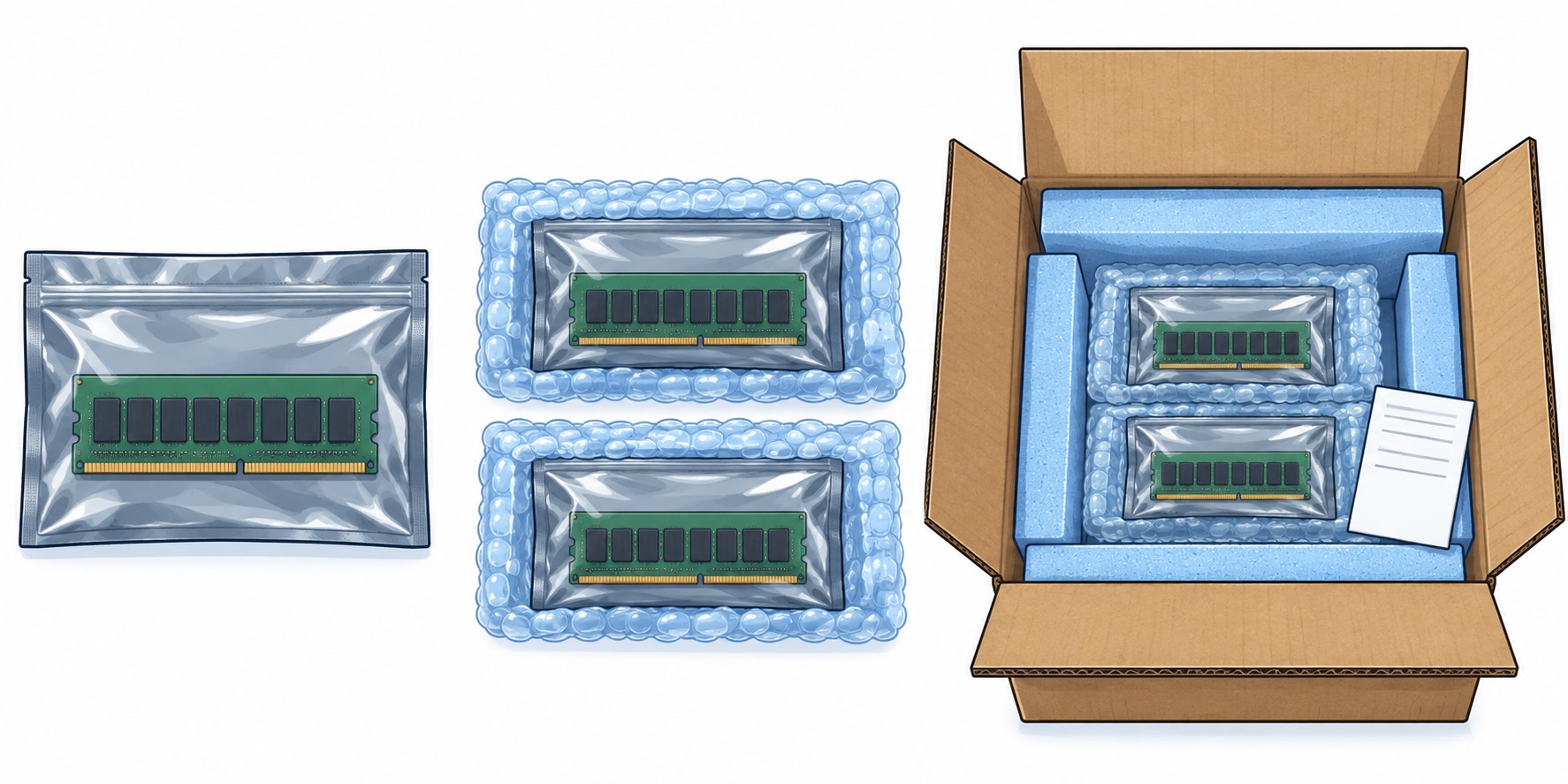
1. Anti-static protection
One module per closed shielding bag, or a suitable ESD-safe RAM tray.
2. Cushioning
Protect the bagged modules individually and prevent movement.
3. A rigid box
Cushion all sides, include your reference and seal securely.
What you need
You supply the packaging. A prepaid label covers the agreed postage service, not a box, bags or cushioning.
- Suitable static-shielding bags or ESD-safe RAM trays.
- Cushioning for the protected modules and to fill gaps.
- A strong cardboard box and parcel tape.
- Your quote reference and inventory on a slip of paper.
Keep product labels and heat spreaders attached. If you do not have suitable packaging, ask us before dispatch—do not improvise with loose RAM in an envelope.
Six steps before dispatch
Check and photograph
Match the part numbers and quantities to your accepted quote. Photograph readable labels and the grouped modules before packing. Tell us about changed contents before using a label.
Protect against static
Handle RAM by the edges, not the chips or gold contacts, and use appropriate ESD precautions. Put each module in a static-shielding bag and close it, or use a suitable ESD-safe RAM tray that holds modules separately. Ordinary plastic bags are not a substitute.
Cushion each protected module
Wrap the closed bags or protected tray in cushioning. Keep modules separated so they cannot collide or bend. Ordinary bubble wrap belongs outside the anti-static protection, not directly against bare RAM. Never tape directly onto a module.
Choose a sturdy box
Use an intact, rigid corrugated cardboard box with room for cushioning on every side, including underneath and on top. A clean, strong reused box is fine: remove old labels and barcodes. Do not use an ordinary envelope or a padded mailer as the only outer protection.
Include the inventory and fill gaps
Add your quote reference and a list of part numbers and quantities inside. Fill empty space so the protected contents cannot slide around, without tightly compressing or bending the modules. Photograph the packing before adding the top cushioning and closing the box.
Seal, label and keep proof
Use strong parcel-packing tape, not masking tape or ordinary stationery tape. Seal the centre seam and both edge seams in an H pattern on the top and bottom of the box. Attach the postage label flat on the top, away from seams and edges, with the address and barcode fully visible. Keep tape off the barcode. Check the packed weight and dimensions against the specific service instructions. Keep proof of posting and tracking. Contact us before splitting a consignment into several boxes—do not reuse one label.
Strong tape. Label on top.
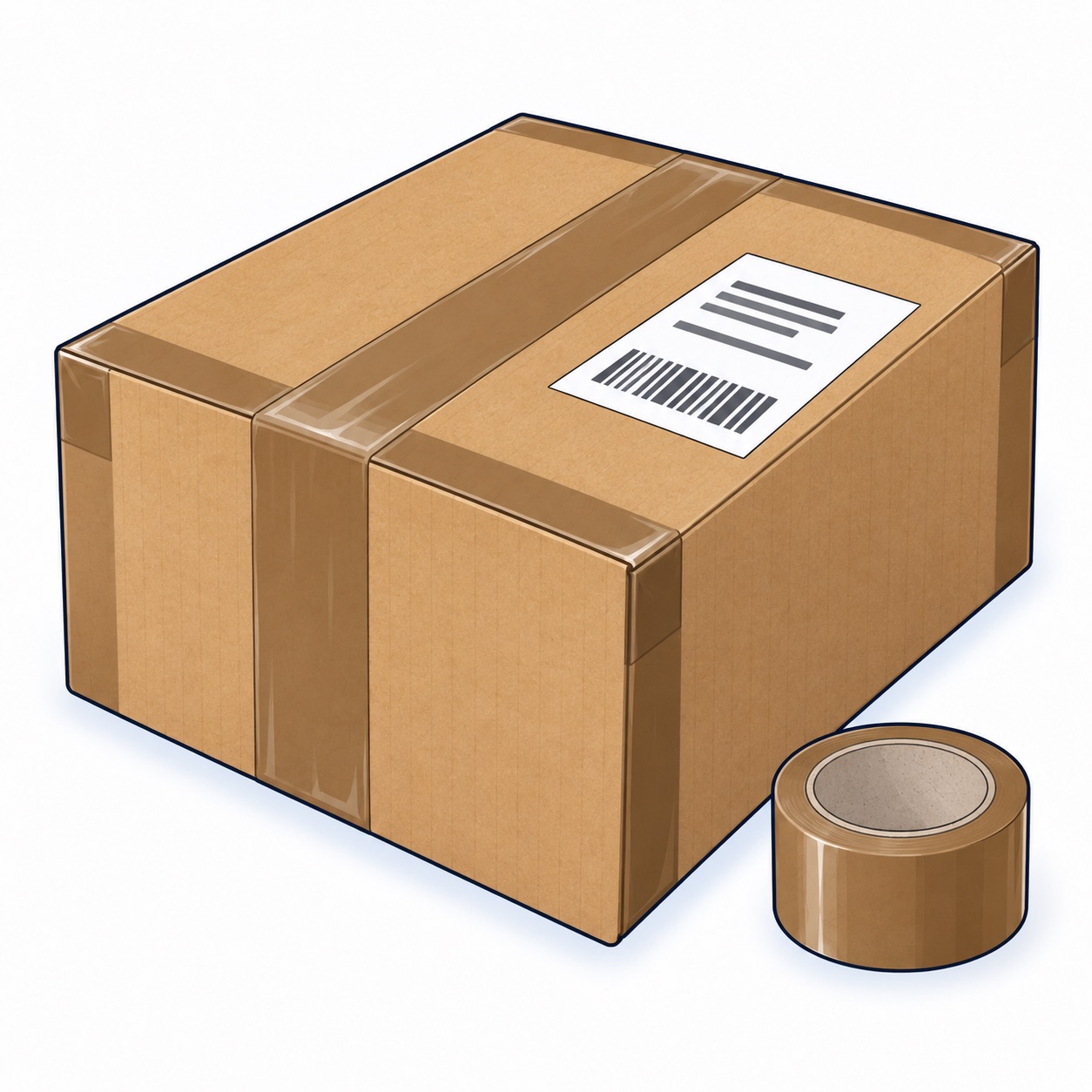
Outside: the postage/address label goes on top of the sealed box. Inside: put the packing slip with your quote reference, part numbers and quantities on top of the protected contents before adding final top cushioning and closing the box.
Avoid these common mistakes
- Loose sticks touching each other in a bag or box.
- Ordinary plastic, bubble wrap or aluminium foil used instead of suitable ESD protection.
- Tape on contacts, chips, labels or heat spreaders.
- A crushed box, empty space inside, or insufficient protection above the modules.
- Sending extra equipment, batteries or goods not included in the agreed quote.
- Using an old shipping label or sending before the receiving address is confirmed.
Bulk or high-value RAM?
Agree the packaging, parcel count and service with us first. Use suitable ESD-safe trays with secure lids and an inventory for each box. Do not assume a label covers any weight, size or value.
Before you hand it over
- Contents match the accepted quote.
- Modules have anti-static and physical protection.
- Nothing slides around when the closed box is gently tilted.
- Quote reference and inventory are inside.
- Photos are saved and the correct label is attached.
- Weight and dimensions fit the agreed service; proof of posting will be retained.
Photos and careful packaging help an investigation but do not guarantee carrier compensation. Packaging concerns are assessed alongside the evidence; they do not automatically prove that the seller caused a fault. See the purchase terms.
Carrier-specific requirements take precedence for the selected service. Royal Mail has not yet been confirmed as our carrier. General references: Royal Mail fragile-item packaging guidance and Kingston memory-handling guidance.